
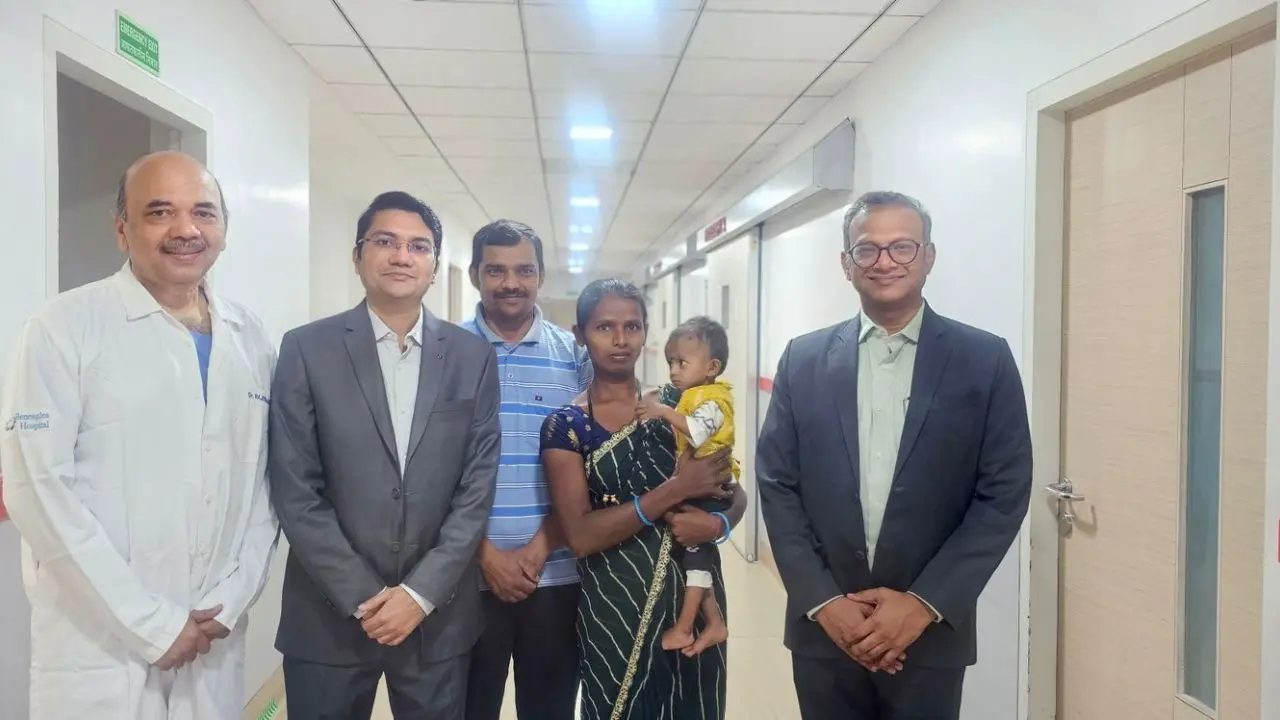
When Pramila Kavar first held her son Neeraj in her arms, everything seemed perfect. He was a healthy baby, feeding well and growing normally in their small village of Chinchore in Maharashtra’s Nashik district.
Like any young mother, Pramila dreamed of watching her child grow stronger with every passing month.
But when Neeraj was around nine months old, those dreams began to fade.
Each time Pramila tried to introduce solid food, a little khichdi, a soft morsel meant to mark a new stage of growth, Neeraj would vomit violently.
What began as an occasional episode soon turned into a frightening routine. Feeding time became a moment of anxiety, followed by tears and helplessness.
Over the next few months, Neeraj’s condition worsened. He started losing weight instead of gaining it. His tiny body weakened, and repeated chest infections took over.
Three bouts of pneumonia left the family terrified. By the time he was 14 months old, Neeraj weighed just 5.9 kg, severely underweight, malnourished, and struggling to survive.
Local clinics offered no answers—some suspected reflux, others a heart-related problem. The treatments changed, but Neeraj did not show improvement. Each unanswered question deepened the family’s despair.
Finally, clinging to hope, Pramila and her family travelled from Nashik to Mumbai to consult Dr Vibhor Borkar at Gleneagles Hospital, Parel.
It was there, after detailed tests including a CT scan and endoscopy, that the truth emerged.
Neeraj was suffering from Achalasia Cardia, an extremely rare disorder in infants, affecting about one in five lakh children.
His food pipe was dangerously dilated, and the valve connecting it to the stomach was tightly shut, refusing to open. Food had nowhere to go. It collected in his food pipe, came back up, and often entered his lungs, causing repeated pneumonia.
For the first time in months, the family had a diagnosis. And with it, a chance at recovery.
But treating Neeraj was far from simple. Traditional options like balloon dilation or surgery were too risky for a child so small and fragile. That’s when the doctors made a bold decision to perform Per Oral Endoscopic Myotomy (POEM), a cutting-edge, minimally invasive procedure usually done in adults.
At just 14 months old, Neeraj would become the youngest child in India to undergo POEM.
The procedure demanded extraordinary precision. Adult instruments were unsuitable for his tiny anatomy.
The medical team, led by Dr Borkar and senior gastroenterologist Dr Shankar Zanwar, modified their approach, using a bronchoscope normally meant for lung procedures.
Working delicately within the layers of Neeraj’s food pipe, they carefully cut the abnormally tight muscle that had trapped his food for months.
There were no external cuts. No scars. But the stakes were immense.
From an anaesthesia perspective, the challenge was just as daunting.
“In such small babies, even passing an endoscope can affect breathing,” said Dr Rajan Daftari, Consultant Anaesthesiologist. “Drug doses had to be exact. There was no room for error.”
After the procedure, Neeraj was kept under close observation. He was not allowed to eat initially, and doctors supported him with tube feeding to rebuild his strength. Slowly, carefully, his body began to respond.
Then came the moment his parents had waited for; Neeraj started swallowing again. No vomiting. No choking. No pain.
Today, Neeraj is feeding well, gaining strength, and finally doing what babies his age are meant to do: grow.
For Pramila, the transformation feels nothing short of miraculous. “For months, we watched our child suffer and didn’t know why,” she said, her voice heavy with emotion. “Now, seeing him eat and slowly become stronger feels like a second life for him.”
Doctors say early diagnosis is crucial in such rare cases, as delays can lead to severe malnutrition and life-threatening infections. Neeraj’s case now stands as a milestone in paediatric gastroenterology, proof that advanced, minimally invasive care can save even the smallest and most fragile lives.
“At Gleneagles Hospital, we believe in pushing boundaries when a child’s life is at stake,” said Dr Bipin Chevale, CEO of the hospital. “This case reflects our commitment to innovation, teamwork, and hope.”
For Neeraj and his family, that hope has finally turned into a future, one meal, one breath, and one smile at a time.
What Is Achalasia Cardia?
Why POEM scores over other treatment options
- Minimally invasive procedure: POEM is done entirely through an endoscope, without any external cuts or stitches.
- Very low recurrence rate: Nearly 95% of patients remain symptom-free after POEM, making it a long-lasting solution.
- Better than balloon dilation: Balloon procedures, commonly used in adults, have a high recurrence rate of around 60%, and symptoms often return.
- Avoids major surgery: While surgery offers similar relief, it involves cuts, scars, a longer hospital stay, and a higher chance of post-procedure reflux.
- Faster recovery: Most patients can start eating by the second day after POEM.
- No external scars or drains: Unlike surgery, POEM avoids wounds on the skin, drains, and multiple healing areas on the body.
- Reduced overall trauma: Healing is limited only to the food pipe, saving the patient, especially children, from the stress of invasive surgery.
- Ideal for high-risk patients: POEM is especially beneficial for small, underweight, and fragile children, where traditional surgery carries higher risks.